- Kindly Do not Post Job, Raw Material & Personal Enquiries

Tablet vs Capsule Manufacturing
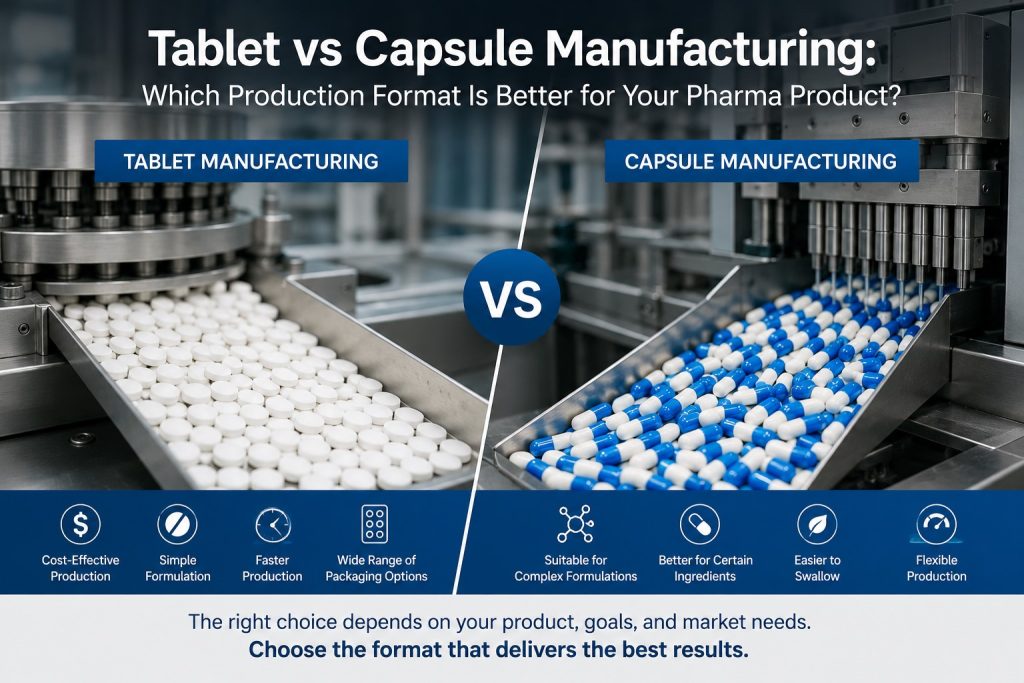
Tablet vs Capsule Manufacturing: Which Production Format Is Better for Your Pharma Product? – Dosage form selection is one of the key decisions made during pharmaceutical product development. While developing a new drug, nutraceutical, or other pharmaceutical products, producers always ask themselves a question: Tablet vs Capsule Manufacturing: Which Production Format Is Better for Your Pharma Product?
Tablets and capsules are two of the most common oral dosage forms, yet they differ in formula requirements, production process, manufacturing costs, stability, patient convenience, and marketing. There are various aspects that should be taken into account while deciding on the proper format for manufacturing the drug: API, dose, market, shelf life, etc.
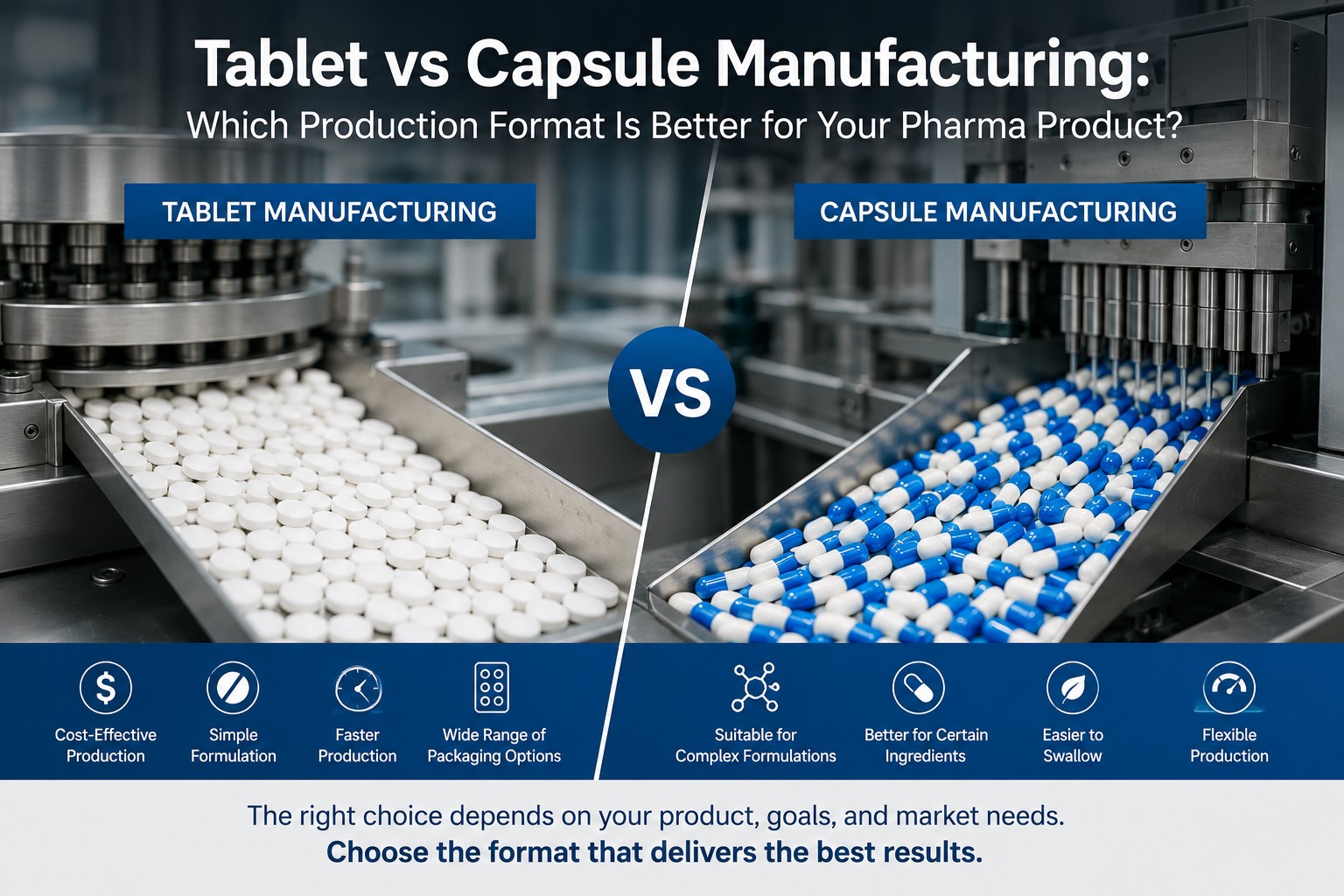
Table of Contents
Tablet Manufacturing Understanding
Production of pharmaceutical products in the form of tablets consists of making an active substance and additives into a compressed solid dosage form. This process includes various stages, depending on the formulation: weighing, mixing, granulation, drying, milling, lubrication, tabletting, coating, inspection, and packaging.
Tablets are especially convenient for large-scale pharmaceutical manufacturing since modern tableting machines allow efficient and scalable production. Moreover, they can be produced in several types, including: immediate release, film coating, chewable, dispersible, sustained release, and others.
The cost efficiency of tablets is one of the most significant benefits. It usually requires less material cost than capsule production since there is no need for the capsule shell. In addition, tablets can give adequate mechanical strength and usually are convenient for transportation, storage, and distribution.
On the other hand, not all APIs can be compressed. There may be APIs with inadequate flowability, compressibility, compression sensitivity, or stability that will require extra formulation development to produce them in the form of tablets.
Understanding Capsule Manufacturing
Capsules usually imply accurate filling of hard or soft capsule shells with powders, granules, pellets, liquids, or other suitable formulations. Special automatic equipment is used to maintain fill weight consistency and an efficient production process.
There are several advantages of capsules as a formulation. They can be used in cases when the taste or smell of the product should be hidden, and their smooth surface can make them more comfortable to swallow. Moreover, capsules can be appropriate in cases when the API cannot be compressed into a tablet.
With certain formulations, capsule filling will be more flexible in terms of providing the ability to deliver the active ingredient in the form of powder, granule, or multiparticulate forms as opposed to using tablets where the active ingredient is delivered after being pressed into a tablet. Capsule shells may be sensitive to humidity.
Tablet vs Capsule Manufacturing: Differences
In looking at tablet vs capsule manufacturing differences, take note of the following:
1. Manufacturing cost:
Tablets are more cost-effective when it comes to large-scale manufacture, whereas capsules will incur extra shell costs.
2. Formulation Flexibility:
Tablets are very compatible when APIs and excipients possess good flow and compression properties. Capsules, on the other hand, offer greater flexibility in the case of certain powder, granule, and sensitive formulations.
3. Patient acceptability:
There are some patients who might prefer capsules as opposed to tablets, especially those that are easy to swallow and do not have an unpleasant smell and taste. Yet tablets have the possibility of being coated or made using other formats to enhance their acceptability.
4. Release Pattern:
Tablets provide great opportunities for formulating the dosage form, such as film coating, enteric coatings, multiple layers, modified release, and others. Capsules, meanwhile, have the ability to use certain types of release patterns based on the capsule type and contents.
5. Stability and Packing:
Tablets may demonstrate good physical stability and have convenient packing options in blister packs, strips, and bottles, while capsules need to be considered carefully in terms of shell compatibility, moisture, packing, and storage conditions.
Which One Is More Appropriate for Your Pharma Product?
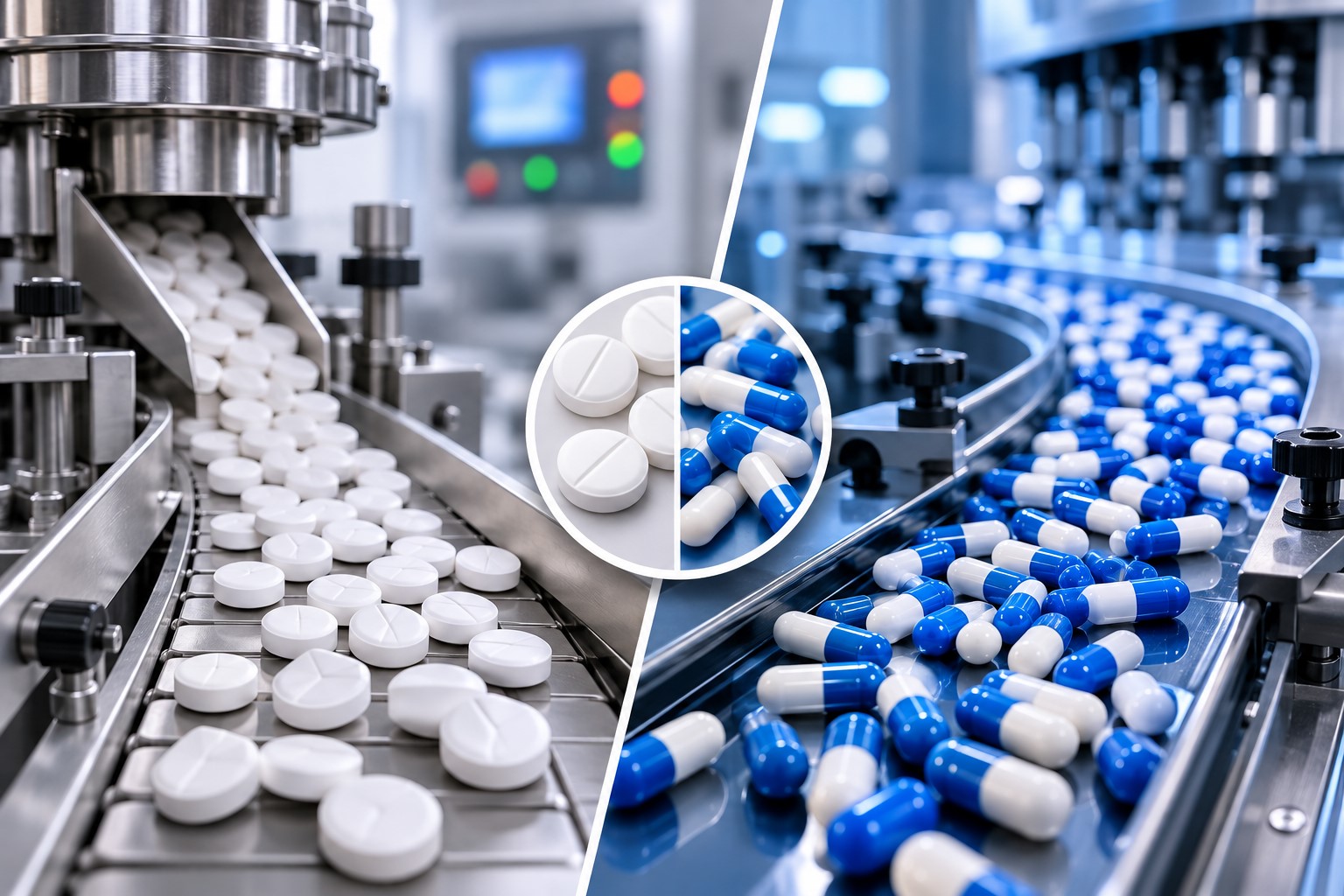
There is no definite answer in the comparison of tablets vs capsules. The best dosage form depends on many aspects such as product formulation, objectives, manufacturing considerations, regulations, and customers’ preferences.
Select tablets if you want to produce high-volume batches, a low-cost dosage form, good physical stability, and modified release.
Select capsules if formulation flexibility, taste masking, swallowing, or active ingredient properties make capsule filling more suitable.
Ideally, the choice should be made during the pharmaceutical formulation development process and not after the design of the product. The right manufacturing partner will assess the characteristics of the API, excipient compatibility, dosage needs, manufacturing ability, stability, packaging, and market requirements before recommending the final dosage form.
Conclusion
Ultimately, Tablet vs Capsule Manufacturing: Which Production Format Is Better for Your Pharma Product? Depends on your formulation, API characteristics, target customers, cost goals, and manufacturing approach. Either format can work well if you get it right.
Lifevision Healthcare provides solutions in various dosage forms, such as tablets and capsules, with an emphasis on quality and scalable manufacturing. Its manufacturing solutions emphasize formulation customization and support for pharmaceutical and nutraceutical formulations.
For pharma brands considering the development and manufacturing of tablets and capsules, Lifevision Healthcare can be considered a manufacturing partner to work with.
FAQs
Are tablets less expensive to produce than capsules?
Yes. Since they don’t need capsules, tablets usually cost less to manufacture at scale and can be manufactured efficiently through high-speed compressing machines.
When would I opt for capsules rather than tablets?
Capsules might be the preferred choice when the API is not easily compressed, where there is a need to mask either taste or odors, or where the formulation can benefit from being in powders, granules, or other forms of fill material.
Which is more stable, tablets or capsules?
While tablets are generally thought of as hardy and stable, the issue of stability is very dependent on the formulation, packaging, API, excipients, and storage conditions.
Is the same pharmaceutical product formulation possible to manufacture both as a tablet and a capsule?
Not necessarily. While the same API can be used for both, the change of dosage form could involve a reformulation effort as well.
How do I go about choosing my pharmaceutical contract manufacturer?
Look for a manufacturer that will have the proper capabilities, quality systems, formulation know-how, production scalability, testing capabilities, packaging possibilities, and regulatory experience.