- Kindly Do not Post Job, Raw Material & Personal Enquiries

Third-Party Pharma Manufacturing Costs & Turnaround Times: A Realistic Comparison
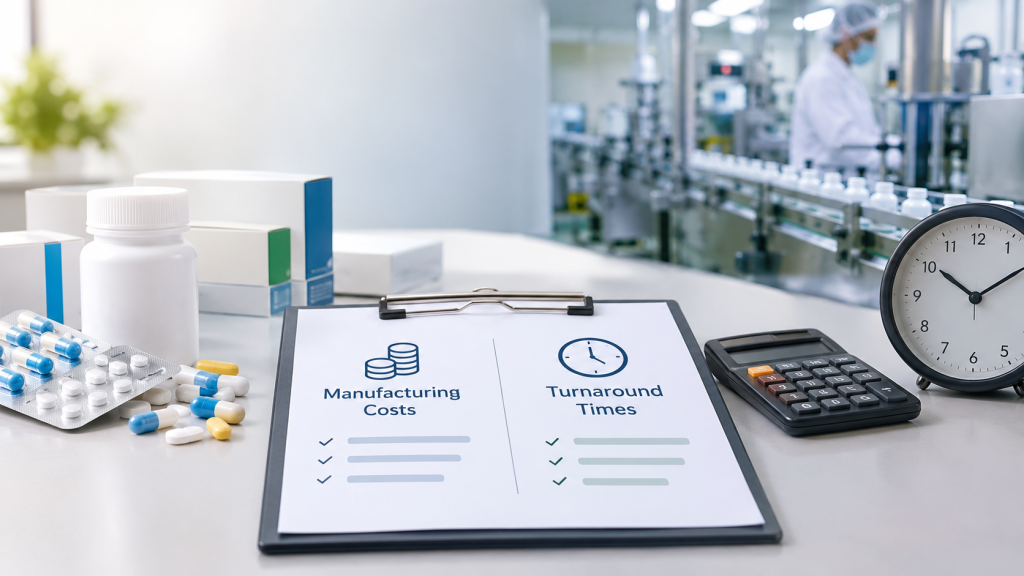
For brands who are planning to launch a pharma brand, the question that always comes up is how much it will cost and how long the process will take. Also known as contract manufacturing, third-party manufacturing lets you launch your own product in the market without actually needing to set up your own plant, hire a team for production, or buy any expensive machinery. Third-party manufacturing is a more practical route for PCD companies, startups, and established brands who are looking to expand.
The honest answer to both questions is that “it depends”. Instead of vague promises, this blog explains what actually drives manufacturing costs and timelines so you can plan and set realistic expectations.
Table of Contents
What is third-party manufacturing?
When you hand over the production part of your business to a licensed manufacturer, it is third-party manufacturing. Formulation, raw material sourcing, production, quality testing, and packaging are handled by the manufacturer himself, and you are just required to bring the product idea, brand name, and marketing plan so that your focus stays on sales and distribution, while your manufacturing partner takes care of compliance and quality.
What Decides the Manufacturing Costs?
Because every product is different, there is no fixed price list to follow. These are some factors that affect the cost of manufacturing the most:
- Dosage form: Syrups, ointments, injectables, and special formulations generally cost more because they require more specialised equipment for sterile processing and stricter testing, which raises the prices, while tablets and capsules are generally the most economical.
- Formulation and raw material: A custom formulation costs more than a common combination that the manufacturer is already producing. Premium active ingredients or imported raw materials for making specific formulations push the prices up.
- Batch size: Producing in larger batches brings down the per-unit cost, whereas smaller trial batches are useful when testing for the market, but per-bottle or per-strip cost increases.
- Testing and documentation: A reliable manufacturer includes quality checks, stability studies and batch records in the process, and its cost is reflected in the total amount. If these are non-negotiable, this cost can’t be avoided.
- Packaging: Blister packs, Alu-Alu, custom cartons, leaflets and special bottles all add up to the final cost and change the final price; many new entrepreneurs underestimate this.
- Licensing and registration: Different products require different approvals; depending upon the product, you may need trademark registration, drug licence support, or other approval, and each of them has its own fees, which add up to the final cost.
How long does it actually take?
Timelines depend upon whether you are using an existing formulation or developing something. New, many buyers automatically assume that production is the slow part, but actually, in reality, manufacturing itself takes days. The rest of the timeline is made up of:
- Artwork and Label Approval (3-7 days): Delays in feedback or last-minute changes are the most common cause that leads to a slow start.
- Raw material and packaging procurement (1-2 weeks): Packaging that is custom printed takes the longest to arrive.
- Manufacturing (2-5 days): The days manufacturing will take depends upon the batch size and product type your company requires.
- Quality Control and Batch Release (1-2 weeks): Before anything ships, analytical testing and documentation happen.
- Final Packing and Dispatch (2-4 days): Timing depends mostly on volume and logistics.
For products that are already in the range of manufacturers, the total usually comes to around 4 to 8 weeks. Whereas custom formulations can stretch this to 3 to 6 months.
Quick Glance at Cost and Turnaround
| Senario | Relative Cost | Typical Turnaround |
| Existing formula, standard packaging | lower | 4 to 8 weeks |
| Existing formula, custom packaging | Moderate | 6 to 10 weeks |
| Custom formulation | Higher | 3 to 6 months |
| Sterile or injectable products | Highest | 2 to 4+ months |
Can Low Cost and Fast Delivery Be Possible Together?
Rarely do low cost and fast delivery go together. When you’re rushing a batch, it will mean paying more for urgent procurement or priority scheduling, while wanting the lowest price may mean waiting for a free production slot, which might delay your product in the market. Deciding what matters and what is required for each product is crucial. A fast-moving tablet may require just a quick turnaround, whereas a new product being tested in the market, which you are only testing, can wait for a more economical schedule.
Common Mistakes That Add Cost and Delay
Planning a few steps can make a noticeable difference in reducing cost and delay.
- Finalising artwork before placing the order.
- Start with formulations that the manufacturer already produces.
- Plan quantities around two or three months of expected sales.
- Ordering specialised packaging materials early since lead times can take some time longer.
- Ask for an itemised quote so you can see where money is actually going.
- Keep at least a two-week buffer in your launch plan.
Conclusion
The right contract manufacturing arrangement balances cost, speed, and quality for your products; understanding what actually drives each of these makes your budgeting and planning the launch more accurate. To discuss your requirements, contact Lifevision Healthcare for an item-wise quotation and a realistic timeline for your products. Contact us today!
Contact No. 08062750200
Mail us at : enquiry@lifevisionhealthcarechd.com
FAQs
How much do third-party manufacturing costs?
There are no fixed rates that are followed; the price depends upon the dosage form, formulation, batch size and packaging. It is suggested that you request an item-wise quotation for the exact quantity and product that you envision.
Can I start with a small batch?
Yes, many manufacturers provide free trial batches; the minimum order quantity depends upon the product and capacity of the machine. In the case of smaller batches, the cost per pack is higher than bulk orders.
How can I get my order to deliver fast?
To get fast delivery, choose an existing formulation, approve artwork quickly, and confirm payment and materials requirements on time; rushing more than this might just raise costs.
Are there any hidden charges?
It is better to check whether artwork, printing plates, testing, freight and GST are included or are charged separately.
Why does custom formulation take up more time to prepare?
As they need development, trial batches, and often market testing before commercial production can begin, which adds months to scheduling.