- Kindly Do not Post Job, Raw Material & Personal Enquiries

What Factors Determine the Shelf Life of a Pharmaceutical Product?

What Factors Determine the Shelf Life of a Pharmaceutical Product? – A pharmaceutical product may appear to be perfect from the external view, but its quality may be affected by time. Its active ingredient may degrade, its liquids may undergo some changes, or its packaging can allow air and moisture entry. That is why the shelf life of a pharmaceutical product is not an arbitrary date set for a medication.
But then, what determines the shelf life of a pharmaceutical product? It is determined by the formulation of the drug itself, the active pharmaceutical ingredient, the manufacturing process, the packaging, the storage conditions, and stability studies. Regulatory bodies require pharmaceutical companies to set expiration dates according to the scientific data proving that a certain product has its required strength, quality, and purity when stored under certain conditions.
Now let us examine the major factors affecting drug stability and shelf life.
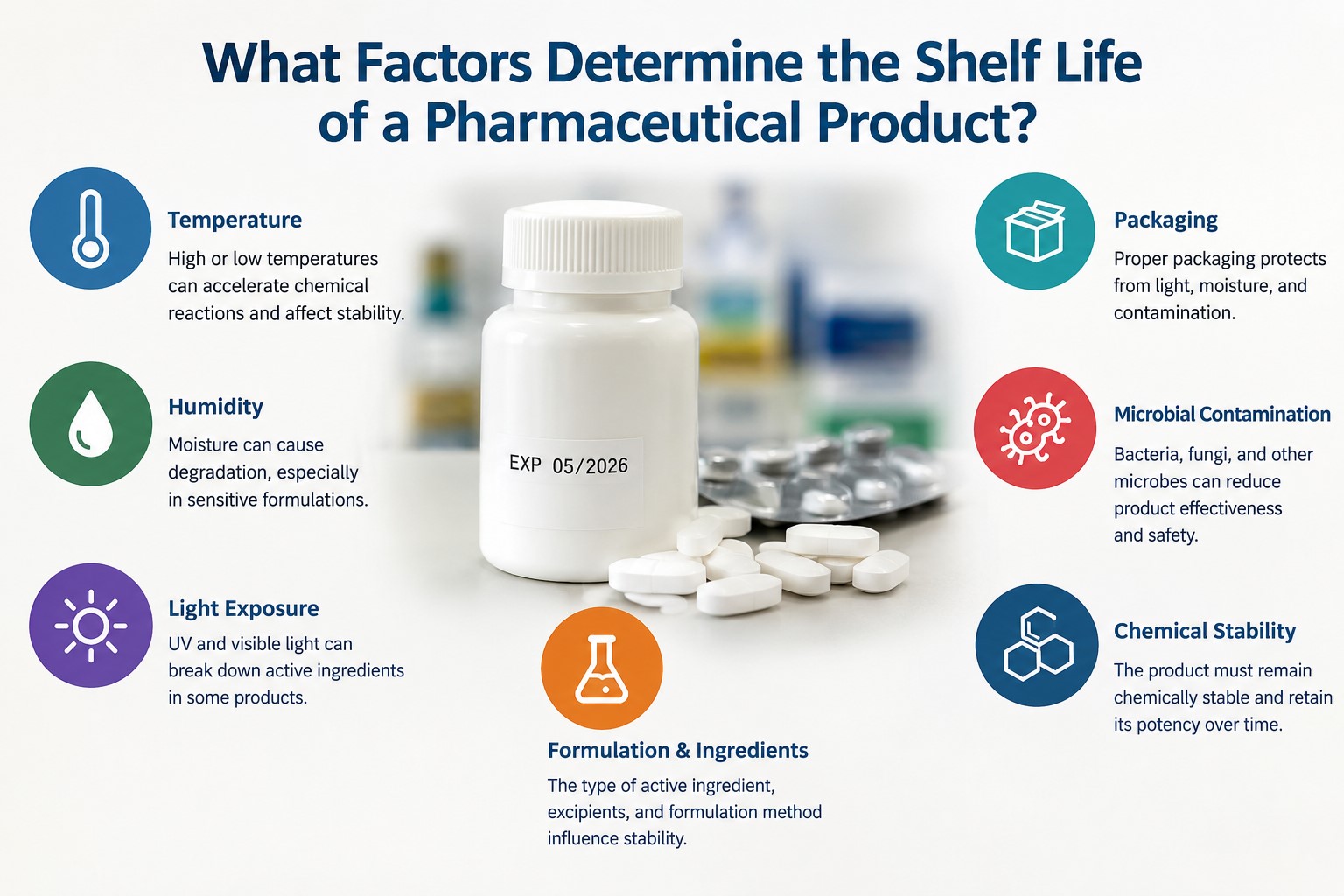
Table of Contents
1. Stability of the Active Pharmaceutical Ingredient
First of all, the stability of the active pharmaceutical ingredient (API) plays a significant role.
Every API will have unique physical and chemical properties. There are some compounds that are very stable, but others will become unstable when exposed to heat, moisture, oxygen, or even light. Instability will decrease the potency of the medicine or create degradation products that should be within acceptable levels.
This is why manufacturers will carry out stability testing in order to find out how long the API and final dosage form will be stable in accordance with the specifications.
2. Pharmaceutical Formulation
Formulation of the pharmaceutical product may affect its stability.
Tablets, capsules, syrups, ointments, injections, and suspensions may behave differently when subjected to the same environment. Binders, fillers, preservatives, antioxidants, and stabilizers can enhance or even affect the stability of the product.
For instance, a good antioxidant can be used to stabilize the oxidation-sensitive compound or even the preservative system in order to control microorganism growth in certain formulations. Guidance on regulations recognizes the relevance of formulation and excipient properties in stability testing.
3. Temperature and Humidity
Temperature and humidity play an important role in the shelf life of medicines.
Too high a temperature may lead to chemical degradation, while too high a humidity level will influence moisture-sensitive tablets, capsules, powders, etc. Some medicines require storage under refrigerated or controlled temperature conditions.
In this way, stability studies examine pharmaceutical products under certain storage conditions, both in long-term and accelerated tests. The temperature and humidity should be recorded during stability storage.
That is why it is necessary for consumers to obey the recommendations on medicine storage found on the product packages. Incorrect storage may reduce the shelf life of the product.
4. Exposure to Light and Oxygen
Photosensitive pharmaceutical components may undergo chemical reactions due to light exposure. Oxygen may also lead to oxidation and decomposition.
For this reason, producers can apply light-resistant packaging, proper container-closure systems, antioxidants, or any other necessary measures. Photostability and other stability studies will show whether the pharmaceutical product is acceptable during the entire shelf life.
5. Packaging and Container-Closure System
Packaging is not just an aesthetic addition to a medicine. It serves as a barrier for the drug and the environment.
The container-closure system may have an impact on exposure to humidity, oxygen, light, foreign substances, and many other factors. The alteration of packaging may affect the stability of a product; that is why stability testing is typically associated with packaging used for marketing.
For sterile pharmaceutical products, container-closure integrity becomes especially crucial since the packaging should be able to provide sterility throughout the shelf life.
6. Manufacturing Process and Product Quality
Manufacturing conditions may also affect pharmaceutical stability. Changes in raw materials, processing conditions, equipment, formulation, or batches become a factor.
This is why pharmaceutical stability testing should be conducted on representative batches and through appropriate scientific methods. Attributes that are usually monitored include assay, degradation products, appearance, dissolution, physical characteristics, microbiology, among others.
The aim of stability testing is simple – to ensure that the drug maintains its specifications up to the expiry date.
7. Data on Pharmaceutical Shelf Life
The shelf life of a pharmaceutical product is based on stability data.
Typically, manufacturers conduct long-term stability tests, accelerated stability tests, and at times intermediate or stress testing. Through these, scientists are able to determine degradation patterns and set the right expiration period.
It is important to note that accelerated testing is not an easy way out of determining an endless shelf life. Degradation patterns under extreme testing conditions may be different from those in regular storage conditions. So, stability conclusions require suitable scientific justification.
8. Dosage Form and Microbial Stability
The dosage form can play a part in the shelf life of the medicine. Different types of solid dosage forms, such as tablets,s might have different stability issues from liquid forms.
For instance, in the case of liquids, some extra problems might occur regarding microbial growth, changes in pH levels, precipitation, or decomposition. Medicines that contain preservatives need evaluation of the preservatives’ activity during their whole shelf life.
Conclusion
Knowing the factors that impact the shelf life of a pharmaceutical product is vital to ensure its quality, safety, and efficacy. From API stability and formulation to packaging, storage conditions, manufacturing process, and stability testing, each of the elements affects the expiration date of the product.
Lifevision Healthcare, founded in 2010, is a pharmaceutical manufacturer and supplier providing tablets, capsules, ointments, syrups, and other pharmaceutical lines. The company emphasizes quality manufacturing, laboratory examination, R&D facilities, and third-party pharmaceutical manufacturing services.
FAQs
What impacts the shelf life of a pharmaceutical product?
The most important aspects include stability of the API, formulation, excipients, manufacturing process, packaging, temperature, humidity, light exposure, microbial stability, and outcomes of stability studies.
How is the expiration date of a drug calculated?
An expiration date is calculated on the basis of results of stability studies showing that the product meets the established standards for strength, quality, and purity during storage at labeled conditions.
Can packaging influence the shelf life of drugs?
Yes. Packaging is designed to protect the medicines from moisture, oxygen, light, contamination, and other environmental impacts. Changes in packaging can have an impact on the stability of the product.
Can high temperature shorten the shelf life of drugs?
Yes. High temperature can increase the speed of degradation of drugs. Therefore, it is recommended to store medicines under their labeled temperature conditions.
Why is stability testing important in the process of manufacturing drugs?
Stability testing allows providing scientific evidence that the drug will comply with the quality standards during the whole shelf life period. It is an essential part of establishing and supporting a shelf life date.

