- Kindly Do not Post Job, Raw Material & Personal Enquiries

How to Evaluate Quality & Regulatory Compliance When Choosing a Third-Party Pharma Manufacturer
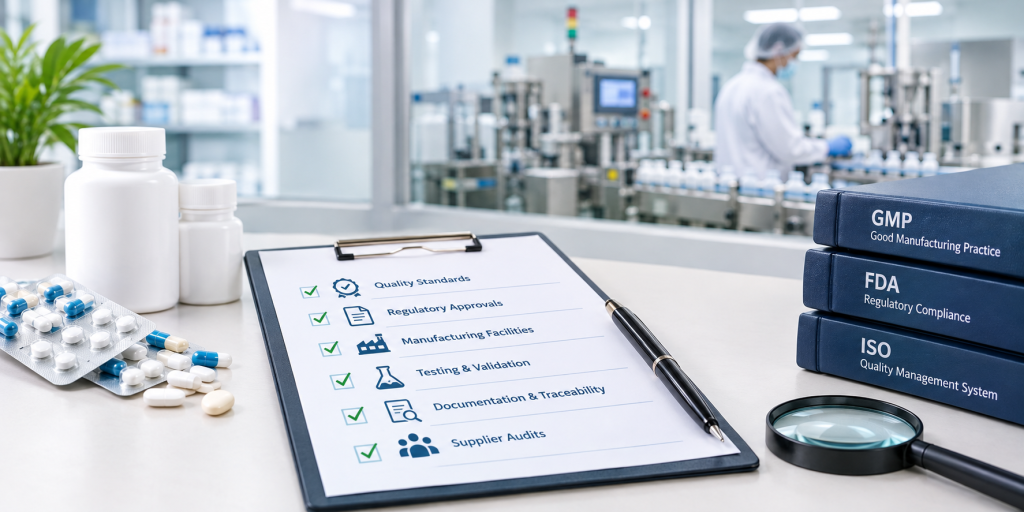
A decision that affects your product quality, your regulatory standing, and your brand reputation for years is choosing a pharma third-party manufacturer in India. When a product leaves a manufacturer’s plant, it carries your brand name and your responsibility. A batch failure or a license issue can delay launches, interrupt supply to distributors, and damage trust that takes years to build. This is why choosing the right pharma manufacturer in India should depend upon verified quality and compliance, not on just price or promises. In this guide we show you what to check, what you should ask for, and what a good pharma manufacturer looks like.
Table of Contents
Outsourcing Production Does Not Outsource Accountability
Technically the manufacturer holds the manufacturing licence, but the company selling the product is still accountable for any reputational and commercial consequences of any quality failure and can also be faced with regulatory questions regarding quality as well. Selecting a partner whose system you can explain comfortably to a regulator or distributor’s audit team.
How to Evaluate Practically
1. Confirm licences and product permissions
Ask for the manufacturing licence issued by the state licensing authority and check for 4 things: is it valid, does it cover the dosage from your requirement, does it list your products, and does the address match the site? It’s better to ask which facility will manufacture your product if production happens under a loan licence and request that licence as well. Many formulations require their own approvals, so it is better to confirm in advance who will be responsible for obtaining them.
2. Check GMP Compliance
Good manufacturing practices are the basis of pharmaceutical quality in India. The revised Schedule M, in December 2023, made the Indian GMP requirement closer to WHO standards, with a bigger emphasis on quality systems, risk management, and documentation. Asking the manufacturer how they have upgraded the facility to meet the requirements, especially air handling, water system, and record keeping. A manufacturer that possesses a WHO-GMP certificate is important if you are planning to export, but check its validity and scope.
3. Examine the Quality System
The system shows what daily habits the manufacturing unit follows. Ask these questions and notice how specific answers they provide.
Independent Quality Assurance
Are QA reports made separately from production, and who is responsible for approving this batch release?
Raw Material Control
Are the suppliers qualified, and is every batch tested as per the specifications?
Testing Capability
How are instruments calibrated, and which tests are done in the manufacturing unit itself?
Stability and Retention Samples
Is stability data available for the product you want, and are samples of each batch retained or not?
Documentation
Can a batch that is finished be traced back to its raw material lots quickly?
Deviation and change control
How are the differences, complaints, changes, and recalls recorded and closed out?
4. Visit the facility in person
Nothing is better than checking directly at the site. Visit the site and look at materials and personnel flow, cleanliness, air handling, and the water system. Check how raw materials are stored and labelled and whether they have separate areas to prevent cross-contamination and how packaging and labelling are controlled. Pay attention to how staff answer your questions and how detailed they explain their own process.
Red Flags to Avoid
- Hesitant to share licence or certificates
- Having certificates that are expired or that don’t match the product type
- No clear separation between QA and production
- Vague quality promises and commitment with very low prices
- Refuse to allow site visit or audit
- Nothing in writing, only verbal promises
Good Signs and Red Flags at Glance
| Area | Good Sign | Red Flag |
| License | Is valid and matches with product and site | Expired, or product not listed |
| Certificates | Current, with having a clear scope | Outdated or unrelated to product type |
| Documents | Shared without any refusal | Delays or refusals |
| Site visit | Open to audit | Visits are limited only up to the office. |
| Pricing | Per-item cost is clear and is tied to specifications. | Very low, with vague promises |
Request these documents before you finalise.
- Manufacturing licence and product permissions
- GMP and WHO-GMP certificate, whichever applies
- Batch manufacturing records a sample certificate of analysis
- Stability data for products you are planning to launch in the market
- Summary of recent regulatory inspections
Conclusion
Evaluating a pharma third-party manufacturer company in India takes some time and effort but protects your brand from my complications that may arise in the future. Verify licences, confirm GMP compliance, examine and test the quality system, visit the site, and keep responsibilities in writing. At Lifevision Healthcare, we are happy to answer your questions and share documents and details you need to make any informed decision. To discuss more about your requirement, connect with us; visit Lifevision Healthcare or get in touch with our team.
FAQ
What licences should a third-party pharma manufacturer in India hold?
At least a valid manufacturing licence that is issued by the state licensing authority that covers the dosage form and products you want to get manufactured. Check if the address on the licence matches the production site.
What is Schedule M, and why does it matter?
Schedule M clears the Good Manufacturing Practice requirements for pharmaceutical manufacturers in India. The revised version, notified in December 2023, audits these requirements more closely with WHO standards, with a larger focus on quality systems, risk management, and documentation.
Can I audit a manufacturer before signing an agreement?
Yes, and you should. A site visit lets you check storage, cleanliness, separation of areas, and record keeping.
Who is responsible for quality in contract manufacturing?
The manufacturer is responsible for producing and testing the product according to GMP. The brand owner remains responsible for choosing a competent partner and overseeing quality.
How often should I audit my manufacturing partner?
Do a thorough review before you start, and then repeat it periodically. Audit again after any major complaint, significant process change, or move to a new facility.
Does a low price mean poor quality?
Not automatically, but it deserves a closer look. Ask what the quoted price includes, such as raw material specifications, testing, packaging, and documentation. A price that is far below others, with vague quality terms, often means something has not been shown to you.


