- Kindly Do not Post Job, Raw Material & Personal Enquiries

The Role of GMP Standards, Quality Control, and Packaging in Modern Pharmaceutical Manufacturing
Key Takeaways
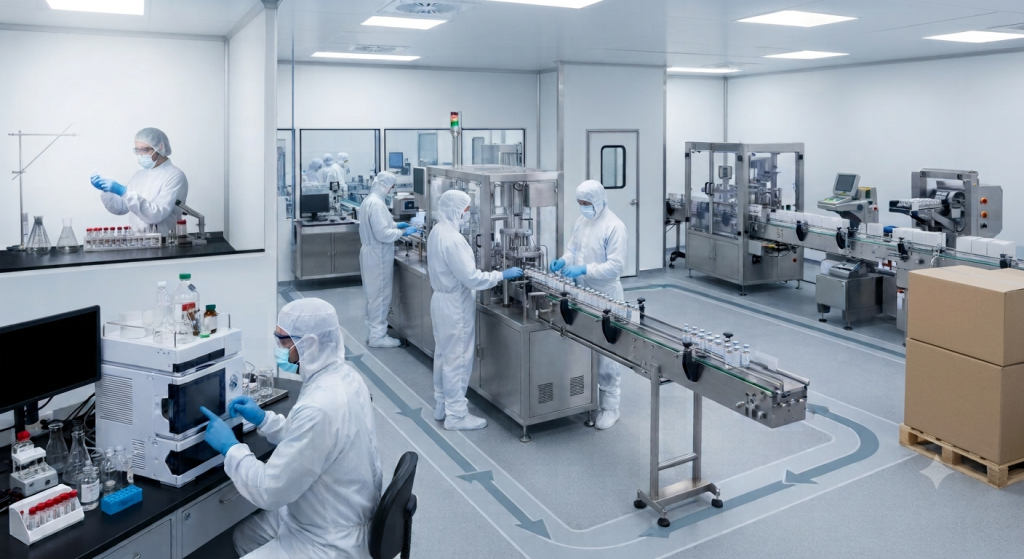
- GMP pharmaceutical manufacturing builds quality into every stage of production, so safe medicines are not left to chance.
- Quality control checks raw materials, in-process samples and finished products before any batch is released.
- Packaging is part of product quality: it protects the medicine, keeps labelling accurate and supports batch traceability.
- GMP, QC and packaging work best as one connected quality system, not as separate departments.
- Before outsourcing, check licences, GMP compliance, testing capability, packaging options and documentation.
GMP pharmaceutical manufacturing is the foundation manufacturers use to create safe and effective drugs. In essence, whether your drugs come as tablets, syrups, capsules or creams, you can be sure that manufacturers make them the same way every time. This occurs because of quality control, rigorous testing, and packaging. In today’s blog, we are going to explore how all this combines to provide a safe drug.
Table of Contents
What is GMP pharmaceutical manufacturing?
GMP is an established set of regulations that helps manufacturers make and control products consistently to predetermined quality standards. It also reduces the chances of cross-contamination or mix-ups during production and ensures manufacturers label every product correctly (World Health Organization).
In India, manufacturing follows the Schedule M of Drugs & Cosmetics Rules, whereas globally WHO GMP guidelines prevail.
GMP pharmaceutical manufacturing involves:
- Facilities that are clean and designed properly
- Skilled and trained staff
- Calibrated and validated equipment
- Certified supplier sources
- Batch records
- Internal auditing.
Why do we need GMP?
GMP pharmaceutical manufacturing practices may help us to maintain quality in the manufacturing process. Manufacturers cannot add quality after production; they must build it into the process. In this way, we can provide our patients with safe medicines. We will have fewer failed batches, fewer recalls, and increased credibility with the physicians, distributors, and regulatory authorities. Proper GMP practice will really help us a lot in the audit.
Quality Control
Once a manufacturer implements GMP, the QC process confirms that it works effectively. Our quality control team will check all our products at different stages of our manufacturing process.
- Testing of raw materials—including active ingredients and excipients — to confirm the correct identity, purity, and strength of the raw material.
- In-process testing – Weight, hardness, pH, fill volume, etc.
- Final product testing – Assay, dissolution, microbial limit, and others. Usually according to Indian Pharmacopoeia standards.
- Stability – Testing products over time to ensure safety until the expiry date.
- Documentation—The team records every result so you can trace each batch back.
The QC team releases a batch only after all testing is complete. This will ensure that there is quality manufacturing.
Packaging: The last step
It is the last step in the manufacturing process. Packaging is a very important process in ensuring that there is quality in the product. Good packaging ensures the following:
- Protection from moisture, light, air, and contamination.
- Labeling of the medication.
- Tamper-proof packaging with secure caps, foils, and cartons.
- Traceability, so you can track any issue to a specific batch.
- Easy to use with instructions and appropriate packaging size.
In GMP pharmaceutical manufacturing, teams clean the manufacturing and packaging areas very carefully. They also remove all labeling and packaging from previous batches.
How they work together
GMP, QC, and packaging work together in a manufacturing process. GMP sets the standards, QC enforces these standards, and packaging ensures that the final product remains safe until it gets to the patient. If one of these three elements falls short, the whole process suffers.. High-quality GMP pharmaceutical manufacturing ensures that these three elements work together as one quality process.
What to look for in third-party manufacturing.
When working with a third party, you will discover that there are different GMP pharmaceutical manufacturing requirements. Make sure you check the following:
- Are they licensed to manufacture and have GMP certificates?
- Are their facilities up to par? Are their cleanrooms, equipment, water system, and storage facilities up to par?
- Is there any testing available? Do their QC labs have the capability to do raw material, in-process, and final product testing?
- Are there any good packaging options? Are there any different packaging options available? Do they have good labeling and artwork services?
- Easy access to batch records and testing? Is it easy for you to get batch records and testing?
- Do they have good auditing capabilities? A good partner should be ready to answer all your questions and even invite you.
Use the WHO guideline for contract manufacturing to understand what responsibilities each side has.
Why choose Lifevision Healthcare?
At Lifevision Healthcare, quality is our foundation. For ten years now, we have been working with pharmaceutical brands through our third-party manufacturing services. We manufacture a vast array of products such as tablets, capsules, syrups, softgels, powders, and ointments. We provide high-quality GMP pharmaceutical manufacturing products by ensuring a robust process, stringent quality control, and effective packaging. Check out some more info, including our antibiotic category, to see what we can do for you here.
Get in touch with us right away and see why we make an excellent partner for building up your own pharma brand!
FAQs
- What is GMP pharmaceutical manufacturing?
These ensure the medicines are produced in accordance with certain standards in terms of facilities, personnel, production lines, materials used, tests conducted, and documentation.
- Why is quality control important?
It makes sure that raw materials, in-process samples, and finished goods are all at the desired level of quality. This way, the risk of failure is avoided.
- How does packaging affect quality?
Packaging is essential in protecting the medicine from water, light, and any possible contamination.
- Is GMP mandatory for India?
Yes, manufacturers who are licensed should ensure that they adhere to GMP provisions, which are set out in Schedule M of the Drugs and Cosmetics Rules.
- How do I select a competent third party?
Select one who is licensed and also has good GMP compliance, quality control, and packaging.